|
| .: Manx tartan |
 The Manx tartan was invented in 1890s after a long-running battle between the ladies of the Island about who could dress the most stylishly on Tynwald Day. The Manx tartan was invented in 1890s after a long-running battle between the ladies of the Island about who could dress the most stylishly on Tynwald Day.
At the annual ceremony in St John’s, it became fashionable for women to wear larger and larger hats to outdo each other. The picture was taken in 1885 and shows Mrs Athenboggle Quirk, who was married to Ayre MHK Fuartangle Quirk.
But the practice had to be regulated after 1887 after a fresh breeze sprang out of the West halfway through the procession of the worthies to Tynwald Hill from the Royal Chapel.
The scale of the hats was out of all proportion to the ability of the human neck to resist, and the wind took hold of the enormous pieces of millinery.
The result was tragedy – eight ladies dead from snapped necks caused by the wind and weight of their hats, and another fifteen seriously injured.
In the aftermath, the more sensible men of Tynwald passed a resolution strictly controlling the size and weight of hats that may be worn on the Island’s national day.
The laws survive to this day, making it illegal for a lady to wear a hat ‘whose highest point doth stand more than three handspans above the highest point of the eyelash’.
In response, the Laxey Woolen Mills created the Manx tartan, a mixture of green, blue, gold, purple and white, and sold a variety of hat designs in the fabric.
Officially, the colours were chosen to fit the following rhyme:
Blue for the Sea,
Green for the hills,
Gold for the gorse,
Purple for the heather,
White for the cottages.
But some Victorian wag quickly adapted the poem and has this alternative version published in the Mona’s Gazette letters pages:
Blue for the mood,
Green for the seasickness,
Gold for the banks,
Purple for the writing of TE Brown
White for the Island bled dry by the English
Although the original poem did survive to the present day, the latter is more widely used in the Isle of Man to describe the tartan pattern.Labels: isle of man, manx, tartan, tynwald
Written at 16:12 by
G
4
comments |
|
| .: Rats and Longtails |
 The Manx gaelic language of the Isle of Man is unusual because for a thousand years it had no letter M. The Manx gaelic language of the Isle of Man is unusual because for a thousand years it had no letter M.
In the early days of Christianisation, the letter was considered unlucky because it was number 13 in the alphabet and the more religious and superstitious types felt that made it ungodly.
In recent times, the letter has been reinstated, but this was part of the reason the Isle of Man was named Ellan Vannin rather than Mannin for so long.
Another popular superstition is the refusal by Manx people to say the word “rat”. This came about in the 1600s after the Duke of Athol, Sir Methadonia Athol, was due to be awarded a knighthood.
He travelled to England to receive his honour from Queen Elizabeth I and returned in triumph.
Sir Methadonia left his ship anchored in Douglas Bay and clambered into a boat to be ferried to shore by the crew.
As he drew near, it became apparent most of the population of the Island had gathered to greet him, and he stood on the prow of the boat, waving vigorously.
Disaster struck as he stepped from the boat to the landing jetty, when he inadvertently trod on a rat which bit his foot.
Yelping in pain, he stumbled, tripped, and fell face-first into a barrel which was waiting to be taken to the ship.
He broke his nose, and, under ancient Manx law, no man with a facial disfigurement was allowed to be a ruling member of the nobility. Sir Methadonia was forced to step down and hand the Dukedom to his eldest son Tastingio.
From that day forward, it’s been considered unlucky for any person to say the word “rat” in the Isle of Man. Upon hearing the word uttered, it’s customary to tug a forelock, knock on wood and whistle.
Instead, you can say "longtail" or "skippo".Labels: duke of athol, isle of man, manx, rats
Written at 16:06 by
G
2
comments |
|
| .: Knockaloe Camp |
 Knockaloe Camp was set up in the Isle of Man in 1914 to house British citizens who were judged to mentally unstable to join the army and fight in World War I. Knockaloe Camp was set up in the Isle of Man in 1914 to house British citizens who were judged to mentally unstable to join the army and fight in World War I.
The site, in the West of the Island, was chosen because it was hidden away in a deep valley between two high hills which were covered in dense forests. The huts to contain the prisoners were built on a flat piece of cleared land, and the camp was given its own railway station.
No track was laid to the station, however, and no trains ever ran there but the internees were told the next locomotive would arrive soon and they were encouraged to wait on the platform where they were more docile and manageable.
The camp was a test site for many psychoactive drugs which were given to prisoners to judge their efficacy. It wasn’t unusual, as one Peel police report put it at the time, to see internees ‘talking to flowers, barking like dogs and attempting to flee from satanic pebbles’.
The Manx government was initially reluctant to set up the camp, but was given huge amounts of money from the UK government as part of the deal. This was used to set up many facilities in the camp to make it appear like a normal town, although as the disturbed inmates were allowed to design it whilst under the influence of mind-altering substances, it bore little resemblance to any sort of town that’s been seen before or since.
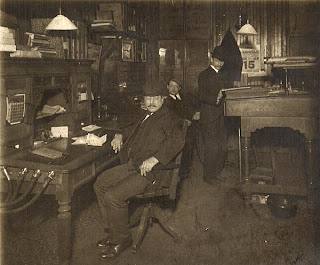
In the picture is Henry the Hat, a popular and well-known inmate who set up the camp’s Post Office. He was instrumental in the postal service which allowed inmates to send internal mail to each other – the government would not, however, allow them to send or receive mail from outside the camp.
Henry the Hat was known for his inability to judge size or perspective and often wore huge oversized flat caps. When he set up the first postal service, he was asked to design stamps and came up with a series of A4 sized postage stamps.
These can be seen clearly in the photograph and would have been illegal under Manx law because they weren’t sticky on the back, had no portrait of the Queen, and often contained tiny, printed swear words.
Today, Henry the Hat’s stamps sell for hundreds of thousands of pounds at auction, and in 1998 Sotheby’s announced one had broken the world record when his original design for the ‘Mona’s bastard Isle’ stamp sold for £8.2 million.
After the war, the camp was closed down and the Manx government found itself in charge of hundreds of mentally ill and incapable people who had nowhere to go. In response, the Isle of Man set up a new town in Upper Foxdale and housed most of the population of Knockaloe there. Many of those still live in Foxdale to this day.Labels: Foxdale, Henry the Hat, isle of man, knockaloe, manx, Peel, word war I
Written at 14:58 by
G
0
comments |
|
| .: Manx Telecom's beginnings |
 Until 1981, the Isle of Man’s telephone network consisted of thousands of miles of underground pipes and “speaking tubes”. Until 1981, the Isle of Man’s telephone network consisted of thousands of miles of underground pipes and “speaking tubes”.
Work began on the Manx All-Island Voice Intertransport System – MAVIS for short – in January 1876, just a month before Alexander Graham Bell patented his first telephone in the US.
Although the Isle of Man government had heard of advances being made in telecommunications, they were firmly of the opinion that voices carried by wires smacked of witchcraft, and so for three months hundreds of Irish migrants were put to work digging deep trenches and laying pipes ready for the technological wonder of the age.
In May 1876, the governor of the Isle of Man, Brigadier Duffus Willingteemy made the first call over the speaking tubes in front of an excited crowd who’d gathered at Government House.
A special pipe had been laid to Buckingham Palace for the call, which was to connect directly to Queen Victoria and help the Manx people feel as though they were a valuable part of the Empire.
But thanks to primitive exchange technology (the main exchange at Douglas is seen in the picture), the call was misdirected to a field on Magnetic Hill where a curious sheep held a short one-sided conversation with the governor.
The mistake wasn’t realised until the next day, as Willingteemy had assumed Her Majesty had been at the gin again. But when he realised he’d been duped, he ordered the sheep roasted and sent to the Queen’s court in London by way of apology.
Despite the shaky start, the speaking tubes continued to be used until in 1981 an enterprising computer hacker managed to connect a BBC Micro computer to the tubes with a home-made acoustic coupler. He then hacked into the computers of a major T-shirt supplier in America and ordered 10,000 shirts with the motto “Mann for the Manx – English Go Home”.
These were delivered to the Manx government’s Legislative Buildings in Douglas, sparking an outcry from the UK government which imagined the Isle of Man was about to secede from Britain.
An investigation was held, but the hacker was never caught because it was impossible to trace calls through the speaking tubes. Manx Telecom, which had been set up by the government to run the system in the 1880s, was ordered to put an end to it and install telephones instead.
This was duly done, but the tubes stay in use to this day as bundles of fibre-optic cables now run through them – connecting the Island along routes first laid down more than 130 years ago.Labels: Brigadier Duffus Willingteemy, isle of man, Magnetic Hill, manx, Manx Telecom
Written at 16:11 by
G
0
comments |
|
| .: Fluffy bunny tale |
 The only full skeleton of an Isle of Man Rabbit ever discovered is currently on show at the Manx Museum. The only full skeleton of an Isle of Man Rabbit ever discovered is currently on show at the Manx Museum.
The specimen is almost four feet tall to the shoulder and was given the latin name cuniculus manximia when it was discovered by archaeologists at Scarlett Point in Castletown in 1962.
The skeleton caused great controversy in the scientific world when it was unearthed by Dr Graeme Qualtrough. He claimed the sheer size of the rabbit meant it was likely to have been the common ancestor of many other Manx mammals, including the Island’s trademark tailless cats.
However, German professor Dr Klaus von Vaffelschnauss was in the Isle of Man at the time and decided to investigate the Scarlett site further. He managed to find two complete human skeletons in strata which was 23 million years old. This led him to postulate the theory that somehow a Manx time machine had been invesnted, its creators had travelled into the past and bred the rabbits for food.
More recently, advances in DNA sampling and genetic technology allowed boffins to clone the rabbit from ancient traces of marrow. They hoped to settle the argument about the animal’s origin once and for all.
But there was great dismay when researchers discovered their specimens missing on the day they were due to mature into adults – and the reinforced cages were severely damaged.
A further batch was created – but in the meantime some leading biologists at the Manx government laboratories claimed the rabbits suffered from an extreme allergenic reaction to sunlight and had exploded as dawn filtered through the windows. This, they said, explained the rarity of the fossils and the animal’s sudden (almost overnight) extinction.
A round-the-clock watch was put on the ancient bunnies, which were kept in a sealed room covered by more than twenty CCTV cameras. This led to one of the most incredible scientific breakthroughs of the twentieth century as the cameras captured the rabbits vaporising with an actinic flash.
Later analysis showed the rabbit’s hadn’t in fact exploded – but they had disappeared. Further scans of the laboratory showed they had spontaneously travelled backwards in time.
A bug in the DNA replication was blamed for the phenomena, and there was a huge amount of scientific activity as various investigators attempted to discover whether the principle could be used to send humans backwards in time.
But the first experiment on a single-celled amoeba proved disastrous when the entire laboratory was all but destroyed in a huge explosion which not only destroyed the subject but also vaporised all of the research data.
Fortunately, nobody was hurt in the blast, but to this day the question remains whether the rabbits existed before the scientists managed to send two batches of them back into the primeval ages.Labels: Douglas, isle of man, manx, manx rabbit
Written at 16:04 by
G
1
comments |
|
| .: Radio Caroline phenomenon |
 Radio Caroline was launched in 1964 and its presenters became familiar faces in the Isle of Man as one of the ships was anchored in Ramsey Bay. Radio Caroline was launched in 1964 and its presenters became familiar faces in the Isle of Man as one of the ships was anchored in Ramsey Bay.
The station was set up by Ronan O’Rahilly who wanted a station that played pop music in order to promote the artistes he represented as an agent.
But the BBC – which had a broadcasting monopoly in the UK at the time – wanted nothing to do with the vulgar hip-swivelling pop acts of the time and so Radio Caroline was born.
Broadcasting began on Easter Day 1964 with a pre-recorded message from Chris Moore – who (it was reported) was too nervous to open the station live.
In fact, Radio Caroline had hit a serious snag just a day before it was due to go live. The transmitters on the ship had been tested with Moore presenting a dummy programme in order to test the signal and studio equipment.
But bizarrely, due to freak climatic conditions in the Irish Sea and its interaction with radioactive outfall from Sellafield, the audio compressors began receiving at an odd frequency.
As a result, the first ever broadcast from Radio Caroline was the transmission of Chris Moore’s thoughts, beamed out live as he thought them.
The phenomenon lasted for fifteen minutes as engineers scurried around trying to find the source of the problem and many broadcasting firsts were set – including the first ever transmission of the words “wanker”, “fuck”, “bell end” and “twat”.
Moore was hurriedly removed from the studio within minutes, but the equipment continued to pick up his brainwaves throughout the ship and transmit them over the music.
He was put on a fishing boat and taken to Ramsey where, once out of range of the ship, the mental transmissions ceased. Although specialists were brought in to solve the mystery, none could do so before the scheduled launch the next day and so Moore was forced to pre-record his entire output for two weeks.
Rumours of the strange incident reached the ears of the CIA who sent a team of agents to seize the equipment two weeks after Caroline had gone live and replace it with a standard, less paranormal transmitter.
The station’s owner, Ronan O’Rahilly, was eager the incident should be forgotten, and nothing was ever heard of again of either the CIA men or the mass of electronics they took with them.Labels: chris moore CIA, isle of man, manx, radio caroline, ramsey
Written at 16:13 by
G
1
comments |
|
| .: The prehistoric Isle of Man |
 The Isle of Man’s early prehistory is fascinating because there are so many theories about how it formed. The Isle of Man’s early prehistory is fascinating because there are so many theories about how it formed.
Well, it certainly wasn’t a lump of earth ripped from Loch Neath which Cuchulain threw into the Irish Sea. And it didn’t rise from the sea as Atlantis sank. And it wasn’t formed by tectonic movements.
No, the Isle of Man was a piece of the moon which fell to earth in the pre-Cambrian period. Recent geological surveys have shown samples of moon rock taken by the Apollo probes in the 1960s are almost identical to chips of stone taken from Poortown Quarry.
This, in part, explains the Isle of Man’s strange positioning on a map as the North-South axis of the Island follows the line of magnetic North rather than true North. And the reason the Island is spaced so evenly between the UK and Ireland is down to simple gravity: the forces of attraction between England, Scotland, Wales and Ireland are all but totally equal, so the Island hasn’t shifted position much relative to those countries.
There is, however, another reason which has remained hush-hush until today.
There has been some shift from its original pre-Cambrian point of impact shown on the map above (the Isle of Man is the small, long piece of land in the semi-circular bay of the Northernmost continent), but this has been due to the Island’s momentum as the Earth spins. Because it isn’t anchored in the Earth’s crust, it is very difficult to stop moving.
In the 1980s, scientists discovered it was slowly sinking Southwards after a crop of palm trees began sprouting. In response, the Manx government poured millions of pounds into a secret fund which was used to buy titanium anchors.
These were dropped from the Northern tip of the Island and secured to Snaefell mountain to prevent any further drifting. At the time, it was thought that once the Island slipped out into the Atlantic Ocean past Cornwall, huge waves would swamp and eventually sink us.
This – indirectly – led to the collapse of the BCCI bank which had been contracted to buy the anchors. Massive cost overruns and interest payments meant the bank simply wasn’t able to trade any more, although this was never discussed at the time.Labels: geology, history, isle of man, manx, prehistory
Written at 16:36 by
G
0
comments |
|
| .: End of the Hu Chi Tau Band |
 So what became of the three members of the Hu Chi Tau band? So what became of the three members of the Hu Chi Tau band?
Bicky Thwaginsack was attacked by seagulls in 1951 and never quite recovered from the experience. He was later killed when he launched himself from Douglas Head in a vain attempt to catch the seagull he thought was behind the attack.
Danko Billy Oofenthwaite gave up music and started up a mobile nightclub on board a bus. He was later arrested and jailed for operating a Wurlitzer organ under the influence of alcohol.
Whilst serving his time in Victoria Road jail in Douglas, he met several prominent Manx gangsters including Juan “Crossword puzzle” Quaggin. He taught Danko Billy the art of scamming crossword compilers with unsolveable clues. Shortly after Danko Billy was released, he was the ringleader in the notorious “23 down” scam.
That eventually led to the American Crossword Society putting out a contract on his life. For a time, he hid in Port Soderick, living in damp caves and eating nothing but shells and pebbles.
Eventually, he discovered the identity of those behind the plot and hired Manx Witch Umbar Creggin to lay a curse on the entire American Crossword Society which resulted in the entire organisation disappearing without trace almost overnight.
Pleased with his success, Danko Billy attempted to perpetrate a virtually identical fraud against the DeutscheKreuzworträtselGesellschaft based in Frankfurt. This time, however, he was not so lucky and the Germans found him. His body was never recovered.
Moirander Leventheep lives on to this day, a broken and bitter man. In 2003 he suffered a breakdown which left him convinced he rules over anybody in the Isle of Man with a J in their name.
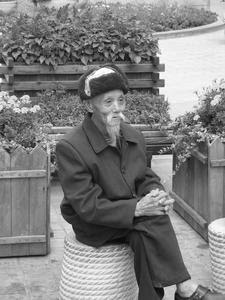
Leventheep keeps himself to himself, although he does make occasional public appearances. The photograph above shows him at an impromptu press conference he gave to announce he’d invented time and was suing the Manx Government for copyright infringement. The case was later thrown out, and Leventheep was forced to pay the costs of both sides of the case.
He can still be found begging in Strand Street to this day.Labels: bicky thwaginsack, crossword, danko billy oofenthwaite, Douglas, Hu Chi Tau Band, humour, isle of man, manx, moirander leventheep, strand street
Written at 17:11 by
G
1
comments |
|
| .: More of the Hu Chi Tau Band |
PART TWO
 Between 1935 and 1939, the Hu Chi Tau Band managed to appear on radio stations no less than four hundred times, often playing accompaniment for other artistes such as vaudeville comedian Big Tommony Tonky and mime artist Leuf Le Feu. Between 1935 and 1939, the Hu Chi Tau Band managed to appear on radio stations no less than four hundred times, often playing accompaniment for other artistes such as vaudeville comedian Big Tommony Tonky and mime artist Leuf Le Feu.
Such was their popularity that during one impromptu gig performed on the dockside in Liverpool, they had to be whisked away by police after a crowd of passengers from a trans-Atlantic liner threatened to tear them limb from limb in efforts to secure a piece of clothing from the trio.
When war broke out, all three did their patriotic duty and volunteered to fight, signing up with the British Army on the first day of hostilities. In keeping with the times, all were sent for basic training, where their talents were spotted. They became part of Field Marshal Bernard Montgomery’s personal retinue. Their job was to provide musical tunes as the backdrop to his travelling drag revue – a motley collection of criminals and hangers-on who’d somehow managed to wangle themselves a place far from the front lines.
This came to an abrupt end in December 1939 when police in London raided a vice den in Kensington and arrested all present – including the Field Marshal, his secretary, mistress, transvestite dancers and the Hu Chi Tau Band.
Few charges were ever brought as the government stepped in to prevent a morale-sapping scandal from engulfing the nation, and the band was given an honourable discharge and sent back to the Isle of Man, where they resumed their season at the Creg-ny-Mallaughinagh theatre.
Here, they found themselves surrounded by foreign nationals who’d been interned in camps such as Howstrake at the start of the war. The internees were mostly Italian and German, with a smattering of Norwegian, French and Tongan. The rich mixture of musical influences this provided is evident in their musical output at the time.
But while they appreciated their newfound fans, they were also sampling the delights of foreign pleasures. Rumours of drug-taking were rife, and the Hu Chi Tau Band’s backstage parties were said by some to have assumed the proportions of Dionysian orgies of free sex and opium smoking.
As word of this filtered around the Isle of Man, servicemen from the RAF base in Jurby began sneaking out of their barracks to see the band for themselves. Eventually, the commanding officer found out and he ordered the military police to take action.
And so, in 1943, armed soldiers entered the theatre and found a frightful scene. Recently released military files contain the reports of the operation leader, Colonel Jim “Bastard” McFrancken. In his words:
"Upon entering the premises, I was struck by an odd odour which one of my men quickly identified as oriental hashish mixed with French perfume and Opium from Cathay.
"As ordered, we conducted a full search and executed on the spot any man found to be wearing undergarments suited to women or any man engaged in unnatural practices. They yammered and screamed, but we did our duty by God. That evening, we dug graves for 87 men –though I prefer to think of them as wretched beasts that crawled upon the land as an affront to Her Majesty the Queen."
Inevitably, this all but finished the career of the Hu Chi Tau Band.Labels: Douglas, field marshal bernard montgomery, Hu Chi Tau Band, isle of man, manx, monty
Written at 16:41 by
G
0
comments |
|
| .: Story of the Hu Chi Tau Band |
PART ONE
 The Hu Chi Tau Band were a band in the Isle of Man during the 1940s and were stationed in Douglas to cheer up the troops here. The Hu Chi Tau Band were a band in the Isle of Man during the 1940s and were stationed in Douglas to cheer up the troops here.
They would often play to prisoners of war in internment camps, and liked nothing better than to mix their traditional Lancashire folk music with the crazy rhythms of other nations.
Their Asian appearance shouldn’t fool you though – they were born and bred in Blackburn and had undergone highly painful scarring techniques using red hot pokers to sculpt their faces into a more oriental appearance.
Bizarrely, this happened before the band members had met each other, and recently unearthed diaries belonging to Bicky Thwaginsack (on the right playing the bongpipe with a saw) told how he’d been amazed to find Danko Billy Oofenthwaite (centre, on tin sticks) and Moirander Leventheep (left, playing the circular spade) had performed almost exactly the same amateur mutilations on themselves.
The trio met in the Cock and Fadger pub in central Blackburn in 1910 and immediately became fast friends. Bicky’s bongpipes were a perfect accompaniment to Danko Billy’s high-pitched voice – although it wasn’t until 1924 he started learning to play the newly-invented tin sticks.
Leventheep was a music teacher to the men working in the zirconium mines in and around Blackburn and taught himself to play the circular spade in 1918 in order to write a song commemorating the end of World War I. That melody, “The Hun is No More” was performed by Blackburn’s mayor from a balcony in the Town Hall a week after Germany’s surrender. Tens of thousands of people gathered for the event, and the trio of musicians realised they had a hit on their hands.
After a short tour of Luxembourg, they settled down in the Isle of Man and were feted by the populace, who’d never heard music before. In fact, it was only the arrival of the Hu Chi Tau Band which persuaded the Manx government to legalise musical instruments in 1935.
This was to be the band's golden age, notching them a string of hit songs.Labels: blackburn, Hu Chi Tau Band, isle of man, manx, music, musicians
Written at 16:03 by
G
0
comments |
|
|
|




As usual another superb post.Wonder if the wearing of tartan would be banne in fightlife"
Luiz"
thiet ke nha
nha xinh
duong vat gia da nang"